A Molted Lobster, a Deal with OpenAI, and the Most Expensive Branding Lesson You'll Never Learn From
The moment your name starts doing the job of a description, it stops doing the job of a name.
Peter Steinberger just announced he's joining OpenAI to work on bringing agents to everyone, and the OpenClaw project he built is moving to a foundation to stay open and independent. It went from a solo developer's open-source experiment to one of the biggest stories in AI in a matter of weeks. Congratulations to him. Genuinely. That is a spectacular outcome by any measure.
It is also, for the rest of us, a masterclass in how not to name a company, and a reminder that surviving your own branding mistakes is the exception, not the rule.
Names Don't Describe. They Distinguish.
This is the most counterintuitive thing founders get wrong, and it's the thing I spend more time explaining than almost anything else in a brand counseling session.
When you name a product or a company, you are not writing a description of what it does. You are creating a signal: something that points to you and only you, something that separates you from everyone else in the room. The moment your name starts doing the job of a description, it stops doing the job of a name.
Don Draper said it better than I can: "Success comes from standing out, not fitting in."
Descriptive names blend in. That's their job. And if it's descriptive, it's not a name.
The MVD Pronto Problem (Why You're Paying for Everyone Else's Marketing)
Drive around any mid-sized city in a state that permits private motor vehicle service companies. You'll find a half-dozen storefronts competing for the same registration renewal and license business. Every single one of them is named some variation of Quick MVD, Fast DMV, Express MVD, EZ DMV.
I have watched customers walk into the wrong one. I have watched people argue about which one they used last time. I have personally seen someone try to describe one of these businesses to its own owner and use a competitor's name. The owner didn't even blink, because it happens constantly.
If your name is so similar to your competitors that customers can't remember the difference, every dollar you spend on marketing goes into a shared pool, if you're lucky. You're not building your brand. You're building awareness for the category, and everyone in the category gets to enjoy it. You are, in effect, advertising for your competition.
This is not a "small" business problem. It scales. Badly.
Eighty Platforms, Few Names
I work at the intersection of law and technology. Right now, if you go looking for AI tools built specifically for lawyers, you will find more than eighty platforms vying for attention and wallet share from the same pool of overworked, skeptical attorneys.
A remarkable number of them are named some combination or variation of jagon that sounds like: Lawyer.ai, LegalBot, AgenticJD, AI Esquire, RoboCounselor, and Juris+AI (to generalize a few).
Every one of those names is telling the customer what it is, not who it is. Every one of those names shares phonetic and semantic space with every other name in the category. And every one of those founders is wondering why awareness is so hard to build. It's not hard to build. You're just building it for everyone. Do think your investors notice?
The Claw Problem
Back to OpenClaw. The name history is even richer than most people know, and it reads like a case study I could hand to a first-year associate.
The project launched in November 2025 as Clawdbot, a deliberate lobster-themed pun on Anthropic's Claude AI. That detail matters. This was not an accidental similarity. Steinberger knew what he was doing and leaned into it. It was clever. It was also a problem waiting to happen.
Clawdbot. The dominant element is claw, derived directly from Claude. The suffix bot tells a customer approximately nothing. Every automation tool, every AI assistant, every chatbot on the market has some variation of bot in its name or branding. You cannot own it. It differentiates nothing. And the base word, said aloud at a conference, in a hallway, over the phone, is phonetically indistinguishable from one of the largest AI foundation models on the planet.
In January 2026, Anthropic reached out by email. No lawyers, no cease-and-desist letter. As Steinberger later described it: "They didn't send their lawyers. They sent someone internally. Kudos, they were really nice." He complied immediately. Good move Peter.
That is about as graceful as this situation ever gets. And it is still a forced rename of a viral project with tens of thousands of GitHub stars, executed under pressure, with no runway to think it through. If you thing the hard dollars of rebranding is expensive, wait till you pay to reaquire the customers you already earned.
Moltbot. The pivot to Moltbot was conceptually clever. Lobsters molt their shells to grow; the metaphor for an evolving AI agent is right there. Steinberger even framed it as "same lobster soul, new shell." But a name that requires that much explanation has already failed its primary job. The rebrand day was, in Steinberger's own words, a situation where "everything that could have gone wrong today went wrong." The X handle was immediately snapped up by crypto scammers. Impersonation campaigns launched under the old name. Fake tokens appeared. Rapid rebranding is not free. The costs are just harder to put on an invoice.
OpenClaw. Three days after Moltbot, Steinberger announced the final name, saying Moltbot "never quite rolled off the tongue." Open is everywhere. Open source. Open architecture. OpenAI. It is a modifier that developers understand and everyone else ignores. It adds nothing distinctive to the brand and borrows heavily from a name, OpenAI, that Steinberger is now literally working for.
The dominant element, after all the stripping away, is still Claw.
The One Thing They Got Right
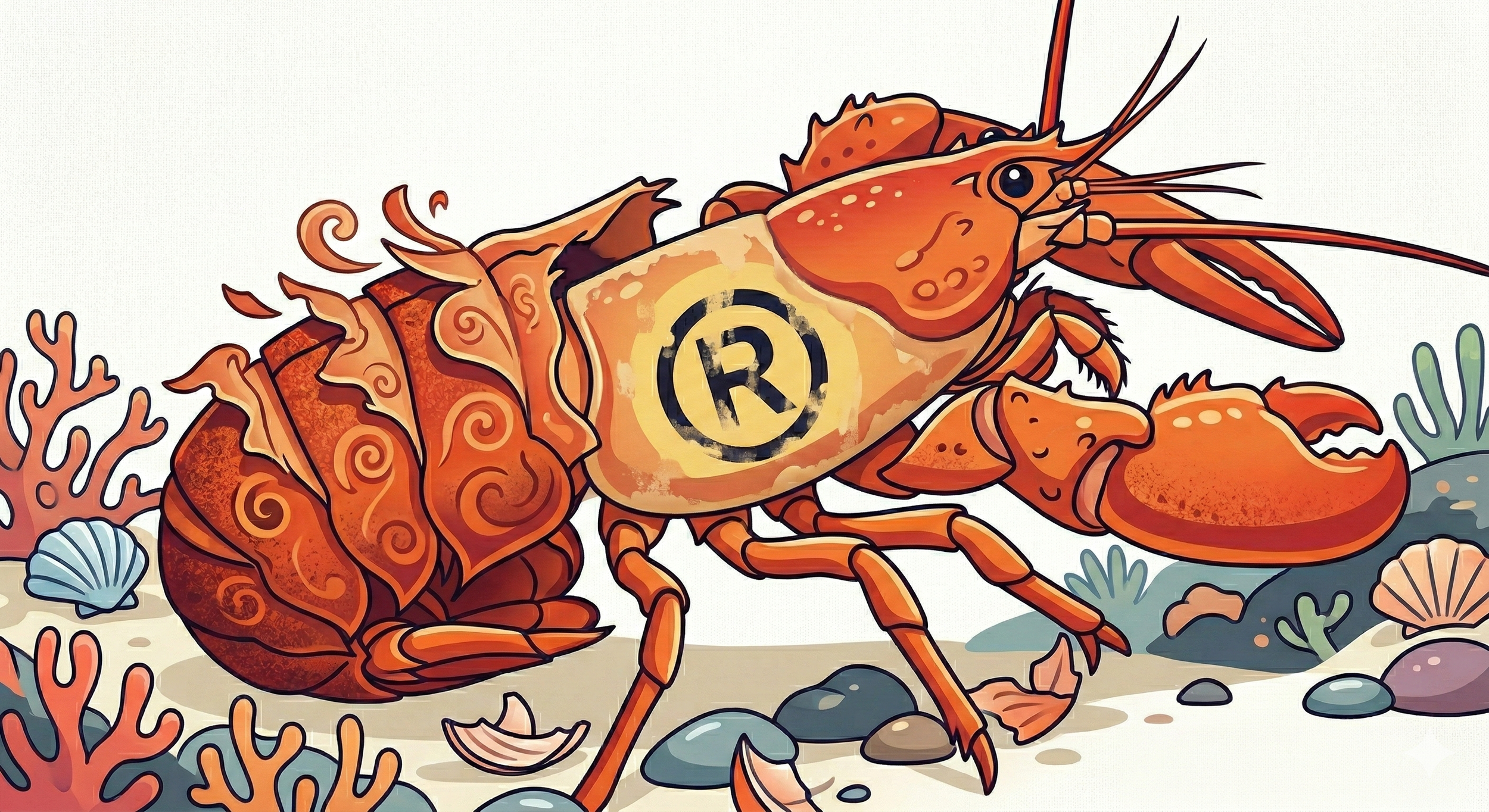
The lobster.
I'll be honest: I cannot draw a clean line from crustacean to agentic AI infrastructure. But I don't need to. That's the point. A lobster is 100% distinctive for a tech company. Nobody else is using it. Nobody is going to confuse it with a competitor. It is weird and memorable and it sticks.
If the visual identity had been a robot, a circuit board, a brain, or any other "AI company" visual cliché, we wouldn't even be talking about it. The lobster is the one moment in this brand's history where someone zigged when everything else zagged.
What I Would Have Done
Had a founder come to me before launch with this name, and they often do, here's how that conversation goes:
I have a couple of custom AI tools I use to help organize the threshold analysis: searching for phonetic confusion risks, pulling trademark availability, flagging descriptive terms that won't hold up. My tool and research would have flagged claw/Claude as a potential confusion risk almost immediately.
But that part is increasingly table stakes. The part that still requires a lawyer, the part that machines genuinely have a hard time replicating, is what comes next.
You sit across from the founder. You tell them something they don't want to hear. You explain that the name they have fallen in love with, the name they've been using internally for six months, the name on the pitch deck they showed to investors, is working against them. You show them why. And then you help them find a better one.
Most founders, when they hear it framed honestly and specifically, are grateful. They came in defensive and they leave relieved. A few ignore the advice. Those are usually the ones who come back later, when the company has grown, when a cease-and-desist arrives, when they're raising a Series B and due diligence surfaces the problem, and the fix is considerably more expensive than it would have been at the start.
Peter Steinberger is a genuinely talented developer who built something remarkable and moved fast enough that none of the branding problems caught up with him. If you are one of the very few who, in a matter of months, builds something so singular that it captures virtually all the attention from a small but intensely relevant community, you have room to make a lot of branding mistakes. That is a rare thing. For the rest of us building companies that have to win in the market over years rather than weeks, the name you choose on day one is an asset or a liability. There is no neutral.
Seth Gardenswartz is the founder of Blackgarden Law, a corporate, finance, and IP practice. He counsels clients on brand strategy, trademark clearance, and technology transactions.
Learn how to protect your kickass brand in < 60 minutes
Are you starting or building a brand and looking to maximize its value? Learn all the basics of trademark and brand protection in this 60-second webinar replay
What you’ll learn from the replay
Recorded with Psychedigital in December 2025, we cover practical steps to move from “cool idea” to ownable asset.
What makes a brand truly protectable, and what to avoid when naming things.
Why familiar, “safe” names often fail basic legal tests.
How to future-proof your mark so it scales with the business.
Where trademarks fit, in plain English, so you can brief your designer and your lawyer with confidence.
A quick thank-you to Psych Digital
Psych Digital produced the deck and hosted the live Q&A. They turned the whole thing into a clean replay so you can share it with your team. It is free for everyone. Psychedigital simply asks that you sign up on their site to watch.
Who this is for
Startups naming a product or parent company.
Marketing teams planning a refresh in 2026.
Operators who want the checklist before they file anything.
Brand is a business asset. If you build it to be defensible now, you will save time and money later. Watch the session, take notes, and share it with the person who picks names at your company.
Kill Bill(able) Hours
Legal billing is a dumb business model. You pay me for the time I spend typing, not for the 30 minutes of insight that actually solves your problem. That model is about to break.
I have always said that legal billing is a dumb business model. You pay me for the time I spend typing, not for the 30 minutes of insight that actually solves your problem. That model is about to break.
No one wants to bury the billable hour with a shovel more than I do. During my brief time as a solo trademark lawyer, I billed exclusively on a flat-rate system. It was beautiful. I didn't have to track my time, my billing was simple, and my clients knew exactly what to expect. Then the real world caught up with me.
When Candice and I founded this firm, the overlap in our practices forced us back to the hourly model. We tried to maintain flat-rate menus. We usually wound up on the losing end. As we like to say, we can only be your flat-rate lawyers if you agree to be our flat-rate clients. That bargain often felt unequal. We were the ones left holding the bag.
The "Scrivener" Problem
Under the current model, I do not get paid for my insight. I get paid for the hours I spend turning that insight into a document11. We are paid for "scrivening" rather than solving.
As Rita Gunther McGrath recently noted in the Wall Street Journal, this logic is becoming untenable. When revenue is tied to time spent rather than value delivered, efficiency actually penalizes the firm.
The AI Paradox
Now we have a brave new world. AI is taking a big chunk of the grunt work out of practicing law15.
Machines can cut the time-consuming part of the job by at least 25% and currently saves 240 hours per year. If I draft a contract in minutes but bill by the hour, my revenue collapses even though I delivered the same or better result in less time. This creates the "economic absurdity" McGrath warns about.
Will this be the death of the billable hour? I sure hope so. But we have a few real problems to solve first.
Client Expectations: Flat rates require efficiency from both sides. If a client wants a fixed price, they cannot have long, rambling conversations that expand the scope or constant changes and edits from the initial plan. We might need a "construction" model with a precise statement of work and change orders for every deviation.
The Risk Factor: As Michael Grupp noted in Bloomberg, the billable hour is resilient because it flexibly manages the risk of the unknown. Clients often prefer paying for precision over a fixed fee that might incentivize cutting corners.
The Ethics Trap: Flat-rate billing is generally permitted. However, true "value billing" is a minefield. Some jurisdictions strictly interpret 'reasonableness' based on time spent, creating tension with emerging guidance, such as Formal Opinion 512, which encourages efficiency. If AI reduces a ten-hour job to ten minutes, justifying a five-figure flat fee under current 'reasonableness' standards becomes risky. Until the regulations catch up to the tech, we are stuck in a gray area.
Let’s Figure This Out
I do not have all the answers yet. I believe clients will eventually demand this shift so strongly that it will become reality, just like the shift from WordPerfect to Word. For now, Blackgarden Law will continue billing as we have. But we are watching this evolution closely.
If you are interested in where this is going, let’s connect on LinkedIn. I would love to hear how your business is handling the shift from paying for time to paying for results.
Let’s figure this out together.
By the way, I used some AI to help me polish this article, but I did so based on my reading of the background materials and my personal experiences.

Brand Refresh Regret
Brand updates sound harmless, until the USPTO asks for a renewal specimen that matches the mark you filed 5 years ago. Close is not enough. Here is how to refresh a logo without putting your registration at risk.
You modernized your tired, old logo, tightened the font, and cleaned up the colors. The update looks sharp across your site, packaging, and social headers. Two years later, the five-year maintenance window arrives. Your lawyer asks for a specimen of the mark as filed, not the glow-up. You search old folders. You find only the new art on every surface. That is the moment many owners realize a brand refresh can put a registration on the line.
Why does this happen? Many businesses register a word + design (“stylized”) mark because it is cheaper, may avoid a conflict (word marks are generally more valuable and broader but harder to get), or feels complete. Over time, brands evolve. A designer updates kerning. A product team adjusts the label hierarchy. A web refresh standardizes color. None of this feels like a new mark. The problem is that trademark maintenance, starting at the Section 8 and 15 filings, requires proof of current use of the same mark you registered. Not a near match. Not a family resemblance. If the commercial impression changed, the USPTO can refuse the specimen.
Once a company rolls out the new look everywhere, the old version often disappears from the market. No labels left in inventory. No product pages with the original design. No email footers or headers to screenshot. Without a clean specimen, owners face a choice: File a new application for the updated design and risk a protection gap as the old registration moves toward lapse, or try to revive use of the old mark in a way that is bona fide, in the ordinary course of business, and do it all fast enough to land a specimen before deadlines close. This is a great way to increase your stress level and legal fees.
There is a calmer path. Treat design updates like product launches. Plan the legal step before the creative rollout. If you will change the logo more than cosmetically, file first. If timing is tight, file as an intent-to-use so the application stakes out your updated look while you prepare the market launch. Maintain limited, real-world use of the old mark during the transition. Capture clean, dated evidence of both versions. Coordinate with marketing and vendors so packaging runs and website changes do not leave you specimen-less.
Continuity is the goal. In practice, that means a defined, documented period where the old design is still used in commerce. This can be a small run of packaging that ships to customers, a product page that keeps the original lockup while the rest of the site updates, or printed materials that remain in use through the switchover. Take screenshots and photos with dates visible or otherwise provable. Store them where you can find them. Treat these images like evidence, because that is what the USPTO needs.
Talk to your lawyer about whether a Section 7(e) amendment might be possible instead of a new filing. This will depend on how materially changed the new mark is in the opinion of an examiner (not the user). Sometimes a new filing is not optional. If a customer would perceive your update as a different look, assume you need a new application. Filing early reduces the chance of a coverage gap and lowers the risk of an opposition fueled by a third party who notices your lapse window. Waiting until renewal season compresses everything, and that pressure leads to poor choices.
Five practical steps before you change a logo
Call your trademark lawyer before your graphic designer. A ten-minute check on the front end can prevent a scramble later and save real money.
Map your dates. Identify the Section 8 and 15 window tied to your registration and work backward. If your renewal window opens on March 1, 2026, plan the refresh and any new filing well before that date.
Decide now, file or finesse. If the update changes the commercial impression, file for the new look. If you are not yet in market, use intent-to-use so the application runs while you prep the rollout.
Plan a documented phase-out. Keep a small slice of bona fide use of the old mark alive until the new registration clears. Do not hard cut over every brand element or touchpoint on the same day. Give yourself room to gather clean specimens.
Build a specimen locker. Save dated screenshots of webpages, product photos in the wild, packaging flats, and labels for both versions. Name files clearly by date and channel so you can retrieve them quickly during the maintenance window.
Cost and timing: a quick reality check
Filing the new mark while the old one remains active is cheap insurance. It reduces the risk of refusal during maintenance and avoids last-minute hunting for specimens that no longer exist. The extra filing fee is modest compared to the cost of an opposition or the loss of a mature registration.
Quick answers to common questions
Can you submit a section 8 specimen for an existing registration showing only the new logo? No. The specimen must match the mark as filed.
What if you cannot find any proof of the current use of the old version? You likely need a new application for the updated design and a strategy for the maintenance filings on the original.
Do tiny font or color shifts matter? They might. The test is based on the commercial impression on a typical customer, not your intent. When in doubt, ask. It is easier to adjust timing now than to fix a refusal later.
If you are thinking about a refresh in January 2026. Send your current registration and the proposed artwork to your trademark professional. They should be able to flag risk, develop a filing plan, and, with your creative team, set up a transition calendar.
This post is general information, not legal advice. If you have a specific issue, contact us to set up a consultation.

How We Use AI to Be Better Lawyers
Thoughtfully integrating AI allows us to provide the high-quality counsel you’d expect from a large firm, but with the personal service and efficiency of a boutique practice.
Every headline screams that AI is changing everything. It certainly is for lawyers. Not because lawyers suddenly fell in love with the tech (as a group, we are generally not early adopters). It’s happening because most clients are, understandably, demanding more efficiency from their lawyers.
As a client, you might wonder: Is this new technology going to save me money, or is it just another complication that I have to learn? We can’t speak for everyone, but here’s our straightforward answer.
Practical Tools
As a boutique firm serving mid-sized and growing businesses, we don’t have the luxury of spending big on experimental tech. We’re not interested in AI for the sake of hype. We’re focused on what delivers practical value to our clients.
Our philosophy on AI is simple and grounded in the same principles we apply to everything we do:
Efficiency. We use AI to automate the time-consuming, repetitive tasks that can slow down and add hours to projects. Think first drafts, summarizing long documents, or conducting initial research. By letting the tech handle that kind of “grunt work,” we can focus our time on what really matters: strategy, negotiation, and giving clients clear, actionable advice.
Human Judgment. AI can generate a contract, but can’t tell you if signing it is a good business decision. It can summarize a document, but it can’t counsel you through a tough choice in negotiations. AI is a powerful tool that helps us work faster, but it’s no substitute for experience and critical human judgment.
Client Value Is the Key Metric. The most important question we ask before adopting any new tool is, “How does this help our clients?” If it doesn’t make our services better, faster, or more cost-effective, it’s not for us. Since a majority of clients now prefer law firms that use AI (and most helpful technology), we see this as part of our commitment to serving you well. Failing to keep up isn’t just a missed opportunity; it’s a competitive risk.
What This Means for You
When you work with Blackgarden Law, you’re getting a team that knows how to use modern tools to your advantage. AI lets us focus our time on providing strategic counsel, while partially automating (some) paperwork. Thoughtfully integrating AI allows us to provide the high-quality counsel you’d expect from a large firm, but with the personal service and efficiency of a boutique practice.
If you have questions about how we use technology to get better results for your business, just ask. We’re always happy to talk about it.

Your Wi-Fi’s Uninvited Guest: What to Know about DMCA Notices
What to know about DMCA Notices
Photo by Bernard Hermant on Unsplash
If you’ve ever received a Digital Millennium Copyright Act (DMCA) notice, you know it can be a bit alarming. But for small businesses like coffee shops, restaurants, breweries, or coworking spaces that offer guest Wi-Fi, these notices are usually about what’s happening on your network, not something you personally did.
Here’s a guide to understanding DMCA notices, why they occur, and how to secure your network to avoid future issues.
What Is a DMCA Notice?
A DMCA notice is a copyright infringement complaint sent to your Internet Service Provider (ISP), which then forwards it to you, the account holder. These notices typically allege that someone connected to your Wi-Fi and downloaded, shared, or streamed copyrighted content—think movies, music, or software—without permission.
The activity often comes from someone using peer-to-peer file-sharing software like BitTorrent, which is commonly associated with unauthorized content sharing. If your business provides guest Wi-Fi, this could be a customer, visitor, or employee.
Am I Liable as a Business Owner?
In most cases, your liability is minimal. As the owner of the internet account, you’re not automatically responsible for what users do on your network. However, repeated issues or ignoring the notices could create problems, including potential service disruptions from your ISP.
Why Does This Happen?
It’s not uncommon for employees or guests to stream, download, or share content using file-sharing software on open networks. For example:
Idle time: Employees may use their phones or laptops during downtime to stream movies or download music.
Guest users: Some patrons may see free Wi-Fi as an opportunity to grab content they wouldn’t risk downloading at home.
Unsecured networks: Open networks without safeguards are an easy target for misuse.
How to Protect Your Business
1. Educate Employees
Remind your staff that using file-sharing programs like BitTorrent is not only risky but also puts the business at risk of copyright claims.
Explain the importance of appropriate internet use during work hours.
2. Secure Your Network
Use a Captive Portal: A captive portal is a layer that adds a login screen for Wi-Fi users, requiring them to use a password or agree to terms (like an acceptable use policy) before accessing the internet. It adds a layer of control even if a password is not required. Program your guest portal to shut down after business hours. You should also change your guest passwords periodically.
Separate Networks: Use one network for back-of-house operations and a separate network for guest access. Avoid leaving any networks open. You can also set your back-of-house network to be invisible to visitors (which seems obvious and simple, but few bother to do it).
Shut Down Unnecessary Networks: If you have redundant guest networks (e.g., a basic guest Wi-Fi in addition to a secure network), consider disabling the extra ones to reduce risks. In particular, many business internet accounts come with something like the Xfinity WiFi hotspots enabled by default. These can create unsecured entry points and should be reviewed and turned off if not in use.
3. Monitor Activity
Many Wi-Fi systems offer usage logs that help identify patterns or repeat offenders. While these logs don’t provide detailed personal information, they can help pinpoint where and when a device is used to engage in suspicious activity.
4. Create a Robust Acceptable Use Policy
Ensure your Wi-Fi terms of use explicitly prohibit illegal activities like copyright infringement. Captive portals can include this agreement for guests to accept before connecting.
5. Respond to Notices Promptly
While a single DMCA notice doesn’t require panic, repeated issues should be addressed. Responding shows that you’re taking steps to secure your network.
Don’t Panic—Be Proactive
Receiving a DMCA notice doesn’t mean your business is in trouble, but it is a signal (from your ISP, not from the universe) to review your network security. Reminding staff about proper internet use or upgrading to a captive portal secured Wi-Fi system with monitoring and policies will help protect your business and reduce the chances of repeat notices.
Running a business is hard enough—don’t let sloppy IT hygiene create avoidable headaches. If you received a notice, consult with a professional and take the appropriate steps.
What the Corporate Transparency Act Means for Your Small Business

Image of faceless people in a corporate setting created using DALL-E 3 with prompts designed by the author.
If you're running a small business, new rules from FinCEN kicked in on January 1, 2024, and it's time to get your act together. Under the Corporate Transparency Act (CTA), many companies will need to disclose their Beneficial Ownership Information (BOI). Sounds straightforward, right? But don’t underestimate this shift—it could impact everything from your internal data management to your relationships with stakeholders.
What Is the CTA, and Why Does It Matter?
In a nutshell, the CTA targets anonymous ownership structures often used to facilitate money laundering and other financial crimes. Small businesses falling under FinCEN’s definition of a “reporting company” must report the people who really pull the strings—those who own or control at least 25% of the business.
Who Needs to Comply?
Not every business has to file BOI reports. Exemptions apply, especially if your business is already subject to significant regulatory oversight (think banks and large operating companies). But if you're a typical small business with a straightforward ownership structure, you’ll likely be on the hook.
What Do You Need to Do?
Start by identifying your beneficial owners. These are the people who have a significant say in your company's operations or who own a substantial stake. Once you've got this information, you’ll need to file it through FinCEN’s secure system before January 1, 2025. Some details about how to do this are below.
Next Steps for Small Businesses
Identify: Determine if your company is classified as a “reporting company.”
Gather: Collect details about beneficial owners, including legal names, addresses, and identification.
Prepare: Familiarize yourself with the electronic filing system that opened on January 1, 2024.
Docket: To avoid penalties, mark the deadlines to ensure you file before January 1, 2025.
Penalties for Non-Compliance
If you miss the deadlines or submit false information, you could face up to $500 in daily fines, not to mention possible criminal charges. The takeaway? Get your information in order now.
For more details, visit FinCEN's site here. If you need additional help, check out these CTA Compliance providers. They are likely cheaper than a law firm.

Thirsty for Authenticity
Authenticity is the rarest and most valuable element in any consumer marketplace. Authenticity cannot be mass-produced. Thus, massive breweries cannot make it. They can, however, destroy it by buying an authentic craft brand and folding it into the undifferentiated six-packs of mediocrity that fill the shelves of most liquor stores.
This post was originally published in January of 2019 on surefi.com. Photo Credit: Matt Durst
Chris Herron wrote a great piece in 2017 explaining how InBev is buying independent breweries to suck the life out of the craft beer community. It’s a fantastic read for anyone who is making a living in craft beer. He points out that “Brand Equity” is not something most small or independent business owners think about, yet it is their biggest asset. Brand equity is what gives successful brands the ability to charge a higher price, acquire favorable distribution and survive setbacks. Herron pointed out that acquiring independent brewers is a sinister (but clever) way for macro breweries to dilute the aggregated brand equity of craft and thus recover the very real damage to their core, mass-market brands.
There is one serious Achilles’ heel in the InBev strategy, as outlined in Chris’ blog. Consumers want something from each brand interaction. In this market, aside from quality, consumers want to be cool. Cool equals special, unique, and separate from the pack. When a person associates themselves with a brand, it communicates something about that person to their peers and themselves. Remember the Apple vs. PC ads? Apple was not saying their features made Apple products worth double the price of a PC. But they proved consumers will pay more for products that make them feel good about themselves.
If InBev is successful in compressing brand equity in the craft market, it will create a space “above” the soiled brands it ingests. That void is for something different that says, “I’m not a follower.” While only a small number of people will understand the difference, those are the all-important influencers or “mavens,” as Malcolm Gladwell called them when describing his “Law of the Few“; the concept that ideas spread through the disproportionately influential acts of a small number of people.
When a consumer buys a craft beer, part of what they are buying is something no macro brewery can make: authenticity. Authenticity is the rarest and, therefore, most valuable element in any consumer marketplace. Authenticity cannot be mass produced. Thus, massive breweries like InBev cannot make it. They can, however, destroy it by buying an authentic craft brand and folding it into the undifferentiated six-packs of mediocrity that fill the shelves of most liquor stores. Massive corporations can make any kind of beer they want, but they can’t “scale” or mass market the passion, sweat, and risk that independent brewers put into their products every day. Being part of that is cool. It’s fun and makes us, as consumers, feel proud of our local brewers and excited to try the variety that the craft industry has brought to our communities. When consumers buy craft beer they are buying authenticity.
The best weapon we have as an industry is our direct relationships with the “fervent few” who visit independent taprooms and spend a dollar more at retail to bring something “cool” (authentic) to the party. While the vast majority of even craft beer drinkers may not know or care that Wicked Weed is now a tool of a multinational conglomerate, the real beer geeks (not the snobs) started making it uncool before the ink was dry on the purchase agreement. InBev will smother the cool in each business it acquires, but it will happen slowly. Craft brewers can speed up the process by communicating authentically and directly with their fans.

Weed is the New Dotcom
The cannabis green rush looks a lot like the dot-com boom. Tech and weed are both financed with equity, use innovation as an advantage, rapid growth, struggle with technical bottlenecks, and exuberant expectations. Given the explosion of cannabis, studying the tech sector can provide helpful insights while navigating the growth of the marijuana business.
Now that cannabis is a legit business, entrepreneurs and investors are eager to cash in on the green rush. But how big can it get, and who is making money from legal weed? From our perspective, the rapidly growing cannabis industry looks a lot like the dot-com boom. It’s not a perfect analogy, but some key aspects of the tech industry mirror cannabis so well that it's a helpful guide to understanding some of the challenges of the cannabis industry as we all try to forecast the future. These similarities include how companies in both sectors are financed, innovation as an advantage, rapid growth, technical bottlenecks, hubris, and exuberant expectations.
Finance: Both cannabis and tech companies are typically funded through equity rather than debt. Generally, no one lends money to develop software because, unlike real estate, there is no collateral if the business does not perform. Banks and other lenders generally won’t lend to cannabis businesses because financing a federally illegal business jeopardizes FDIC insurance, removes the process of federal bankruptcy, and is generally riskier. Therefore, cannabis entrepreneurs have to fund their businesses through equity, which means selling part of the company to raise cash. If the business succeeds, everyone makes money. If it fails, the investment often goes to zero, and most investors walk away with only losses. This financial model is classic in the tech startup world. As a technology lawyer now working with cannabis startups, this investment paradigm is hauntingly familiar.
Innovation: Innovation and potential disruption of legacy industries is a competitive advantage in tech and cannabis. Cannabis companies are developing new genetics, better processes for growing, and innovative products such as topicals, “fast-acting” edibles, and concentrates formulated for specific effects. Similarly, tech startups constantly innovate to create products and services that take advantage of technologies like the “internet of things.” The cannabis industry can potentially disrupt the pharmaceutical and alcohol industries. Over the past few decades, the technology sector has disrupted (or disintermediated) almost every industry it has touched, notably media, retail, and transportation. There is also an emerging “canna-tech” sector that combines the two industries. Novel e-commerce, gig-work services, media, grow-tech, and resource management software platforms are striving to be the Levi Strauss of the green rush.
Growth: Both cannabis and tech have exploded, at least in terms of the number of companies and interest in investment. The legal cannabis industry has grown due to existing demand along with legalization in many states, while the tech sector has experienced extensive growth due to innovation and the rapid adoption of digital solutions, especially during the pandemic. In addition to e-commerce and web-conferencing, the pandemic also increased cannabis adoption.
Hubris: In both industries, founders often believe their product is better than everything else. In tech, it manifests as “my app will revolutionize the [insert name of niche industry].” In cannabis, you may hear things like, “we grow the best weed.” Really? On the one hand, the confidence that you have something new to contribute is part of what inspires people to start a business. On the other hand, while confidence can be a helpful trait, it's also important to recognize the limits of this mindset. Everyone thinks their product is better than others, but subjective quality rarely creates market dominance. Does Domino’s make the best pizza? Comprehensive research suggests otherwise. But it’s the most popular because they sell the best solution to the problem most people have, which is where to get a predictable, filling, and cheap meal for any number of people in less than 30 minutes.
Dependence on experts: When Apple’s App Store opened, it exacerbated an already intense battle for technical talent to build a new generation of software and mobile applications. Smart and experienced entrepreneurs struggled to find experienced developers to write and maintain code in a rapidly evolving technology market. Many cannabis green rushers find themselves in a similar predicament. The plant is difficult to grow at any commercial scale. In most newly legal (or expanding to recreational) markets, there are not enough growers to manage all the new operations. Furthermore, many “experienced” growers got that experience under a different regulatory environment. Adapting to a new, state-regulated system with investors and employees is not a smooth transition. Hence new cannabis businesses are as beholden to their growers as tech firms were to software developers at the peak of the boom.
Expectations: These industries' final similarity (and perhaps the biggest pitfall) is that everyone thinks they’ll get rich in a few months. We all know the image of some pimple-faced teenager cashing in before zipping into the sunset after some big company buys them out. Sure, that happens occasionally, but the brutal truth is that 90% of startups fail. Of the remaining 10%, not all are home runs. But FOMO keeps the investment dollars and entrepreneurial juices flowing. People may think the cannabis industry is a surefire way to make money fast; it's “new” and in high demand, some even calling it a “license to print money.” Think again. The cannabis industry is not a place you can throw a few seeds in the ground and sell whatever grows for a quick profit. It has the combined complications of farming, manufacturing, retail, and some hybrid of pharma/alcohol, plus an extremely complicated and evolving taxation and regulatory environment. Everything is more difficult (aka “expensive”), including banking, taxes, leasing, and employment, to name a few. It takes creativity, business savvy, and much more time and money than most people seem to expect to be a successful cannabis company. Opening a cannabis business should be approached like any other start-up: with eyes wide open and reasonable expectations. Profitability for successful cannabis startups is often years after the initial investment. Be wary of opportunities that promise, or investors that expect, a rapid return on investment. As markets mature, the “wholesale price of cannabis flower” generally trends lower, while the capital costs for lights, irrigation, construction, and labor increase with inflation. In short, the formerly big margins have been harvested.
Differences: There are many differences between cannabis and tech, but some key ones include regulation and scalability. The tech business started out with little to no regulation. As small startups have grown into near monopolies and tech invaded every aspect of our lives, it is drawing more ire and attention from regulators. The cannabis business started heavily regulated, including, for example, laws like Section 280e that have unintended burdens on otherwise legal entrepreneurs. Scalability is another enormous difference. If you build a SaaS software application, the marginal cost of supplying it from 100,000 to 1,000,000 users is relatively small compared to that kind of growth in a cannabis operation. The raw material in cannabis is an agricultural product that must be grown, tested, processed, cured, and finished by manufacturing or packaging. Each state can restrict the number of licenses or plants that can be grown under a license, directly preventing scalability. Furthermore, the security and transportation of the product is a massive undertaking.
While the legal cannabis business effectively began over ten years ago, this industry is still very new. It will undoubtedly evolve in surprising ways over the next few years. The future is impossible to predict, but studying the tech sector may provide some helpful insights while navigating the growth of cannabis. Tech operates in a funding cycle (sometimes characterized as a bubble) driven by investor sentiment, market conditions, and unforeseeable events like a global pandemic. The cannabis market is driven by some of the same (i.e., the pandemic) and also some different market forces, including oversupply, complex regulation, and a thriving black market. Some in the cannabis market see an opportunity for consolidation of distressed assets in the coming year. Tech may not offer a crystal ball for the future of the cannabis business, but I think it can illustrate some of the pitfalls and opportunities participants are likely to encounter along the way.
Written with help from Lauren Leland

Stoner Candy Buzz Kill


Sweet Cannabis Trademark Infringement
Almost everyone in the cannabis space understands that they can’t get federal trademark protection for goods or services that violate federal law. However, that does not mean that naming a dispensary “Starbuds” or packaging goods to look like Skittles is fair game.
Mars Inc. recently filed lawsuits against five marijuana manufacturers for selling edibles that look a lot like Skittles, Starburst, and Life Savers. As reported by the New York Times, the candy makers are not amused. What is unclear is how the defendant(s) developed their “strategy” and if they thought about getting legal counsel to build and protect their brands.
Perhaps they assumed that since trademarks are not obtainable for THC products (or other things illegal under federal law) these were fair game. This is not true. Mars Inc. holds valid federal trademarks for these brands, which are valuable given the massive global sales volume behind those products. Additionally, Mars Inc. is a public company so the officers and directors have a fiduciary duty to protect their marks as assets of the company.
Trademarks are a form of “IP” and the P stands for property. A property right means that the owner can keep someone else off their lawn, out of their building, or from using a confusingly similar name or logo. Cannabis entrepreneurs need to understand that intentionally making a cannabis product look, feel, and sound like another brand (especially a big one) is begging for a fight they can’t win and cannot afford to lose (a defendant infringing a federally registered trademark can be liable for statutory damages and attorneys fees). As a general rule choosing a name or logo because it brings to mind another brand is generally a bad idea.
In addition to the potential brand confusion, it is reckless and irresponsible to package a cannabis product in such a way that children can easily mistake it for the legal junk food that is too big a part of the American diet. As the cannabis industry continues to mature, manufacturers need to demonstrate that they are not wantonly flouting the law and putting kids in peril. If further acceptance and legalization efforts are to be successful it is foolish to give the opposition ammunition like the examples above.
The smart way to brand a cannabis product is to choose something distinctive so consumers will associate the brand with your company and not as a rip-off of someone else’s success. Remember, a brand does not make a business more valuable. It’s the other way around. As a business achieves some recognition (for quality, consistency, or other metrics) its brand becomes valuable because consumers associate the brand with those qualities. So start with a unique brand, that does not describe your product, and sets you apart from the other players in the industry. If the business becomes successful you will forever be grateful that you spent the time to do it well.
Photo Credit: Matt Durst www.flickr.com/photos/thirstydurst/
The article was originally published on surefi.com in January of 2019